“The virtues of donations are great, because it helps the needy and at the same time it gives an opportunity to the donor to give the surplus to the people in need ” - Sama Veda

Search This Blog

Showing posts with label Dwadashi. Show all posts

Wednesday, August 14, 2013

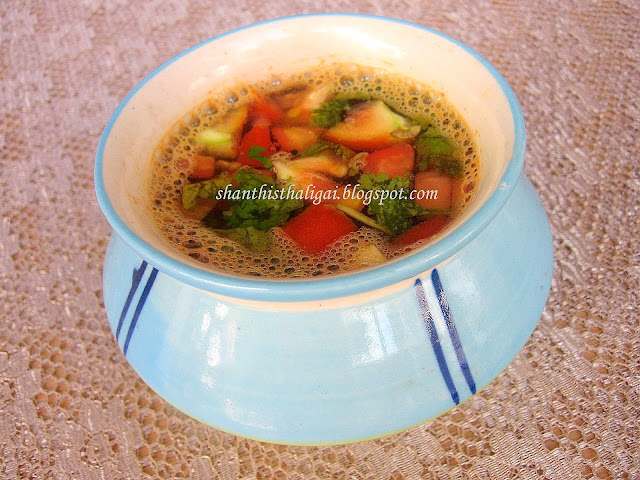
LEMON RASAM

How to make lemonr asam?

INGREDIENTS:

Toor dhal - 1 tablespoon
Lemon - 2
Tomato - 2 medium sized

Slit green chillies - 2
Rasam powder(sathamudhu podi) - 1 heaped tablespoon
Hing
Salt
Curry leaves - few
Coriander leaves - few
Mustard seeds - 1/2 tsp.
Cumin seeds - 1/2 tsp.Ghee - 1/2 tsp.

METHOD:

Pressure cook toor dhal, mash it and keep aside.

In a utensil, squeeze the tomatoes, salt, slit green chillies, rasam powder, and hing , add a cup of water and bring it to a boil till the raw smell of the rasam powder goes. Now add mashed dhal, two more cups of water and mix well. Boil till frothy. Turn off the stove. Squeeze the juice of  2 lemons. Mix well.

In a kadai, heat ghee, temper with mustard seeds, cumin seeds and curry leaves. Add it over the rasam and garnish with chopped coriander leaves. Your spicy, tangy lemon rasam is ready.

LEMON RASAM

How to make lemonr asam?

INGREDIENTS:

Toor dhal - 1 tablespoon
Lemon - 2
Tomato - 2 medium sized

Slit green chillies - 2
Rasam powder(sathamudhu podi) - 1 heaped tablespoon
Hing
Salt
Curry leaves - few
Coriander leaves - few
Mustard seeds - 1/2 tsp.
Cumin seeds - 1/2 tsp.Ghee - 1/2 tsp.

METHOD:

Pressure cook toor dhal, mash it and keep aside.

In a utensil, squeeze the tomatoes, salt, slit green chillies, rasam powder, and hing , add a cup of water and bring it to a boil till the raw smell of the rasam powder goes. Now add mashed dhal, two more cups of water and mix well. Boil till frothy. Turn off the stove. Squeeze the juice of  2 lemons. Mix well.

In a kadai, heat ghee, temper with mustard seeds, cumin seeds and curry leaves. Add it over the rasam and garnish with chopped coriander leaves. Your spicy, tangy lemon rasam is ready.

Thursday, January 5, 2012

DWADASI PAARANAI THALIGAI


Ekadasi vratham is observing total fast (suddha upavasam) on Ekadasi tithi. Those who cannot observe a complete fast, the elders and children are permitted to observe this vratham by taking fruits and milk. People fast on 'Ekadasi' day and have 'Dwadasi Paranai' (special food or thali) on the next day which levels the acidity and the menu by itself is fantastically medicated. We don't use tamarind for this thaligai(samayal). The menu is as under: Click on the numbered recipe names for the recipe links. Pics of the recipes are towards the end of this post.

1. Rice
2. Mor kozhambu
3. Agathi keerai kariamudhu (poriyal)
4. Poricha kootu
5. Poricha sathumudhu(Poricha rasam)
6. Nellikkai pachadi or Nellikai thogayal
7. Akkaravadisal or any  kannamudhu (payasam)
8. Sundakkai vathal fried in ghee
9. Curd


Rice
Mor kuzhambu
Nellikkai pachadi
Nellikkai thogayal
Agathi keerai kariamudhu
Poricha kootu
Poricha sathamudhu


Akkara adisil


Thursday, November 18, 2010

AGATHI KEERAI KARIAMUDHU / AGATHI LEAVES CURRY


This is a famous Iyengar kariamudhu (curry) which is made on Dwadashi days. People fast on 'Ekadashi' day and have 'Dwadashi Paranai' (special food or thali) on the next day which levels the acidity and the menu by itself is fantastically medicated. We don't use tamarind for this thaligai(samayal). The menu is as under:

1. Rice
2. More kozhambu
3. Agathi keerai kariamudhu (poriyal)
4. Poricha kootu
5. Poricha sathumudhu(Poricha rasam)
6. Nellikkai pachadi or Nellikai thogayal
7. Akkaraadisil or any kannamudhu (payasam)
8. Sundakkai vathal fried in ghee
9. Curd

Known as agathi in Tamil, gaach munga in Hindi, avisi in Telugu, agase in Kannada and akatti in Malayalam, agathi leaves have medicinal properties and removes toxins from the blood. Boiling agathi leaves in water and drinking the water kills the germs and bacteria in the stomach. Yet, it is not supposed to have agathi leaves daily. It can be made once in 15 days and can be consumed only twice a month and that is why our ancestors have made it a point to consume it on dwadashi days. Coming to the recipe,

INGREDIENTS:

Agathi keerai - 1 bunch
Sundaikkai vathal (Dried turkey berry) - 10 nos.
Coconut scraped - 1/4 cup
Sugar - 1/4 tsp.
Salt - as per taste
Mustard seeds - 1/4 tsp.
Urad dhal - 1 tsp.
Dry red chillies - 1 or 2
Turmeric powder - a pinch
Oil - 1 tsp.
Ghee - 1 tsp.

METHOD:

Take out the agathi leaves, discard the stem and chop it finely. Boil it in water alongwith turmeric powder and salt till done. Drain the water completely (Do not discard the water, and this can be drunk).

Heat ghee and fry the sundaikkai vathal (dried turkey berry) till dark brown. Keep aside. Heat oil and temper with mustard seeds, urad dhal and chillies. Add the boiled agathi leaves, sugar and coconut. Saute well and finally add the fried sundaikkais. Mix well and this is an excellent side dish with Dwadashi meal.

Tuesday, April 6, 2010

CHOW CHOW KOOTU

INGREDIENTS:

Chow chow - 1/2 kg
Moong dal - 2 tablespoons
Turmeric powder - 1/4 tsp.
Pepper - 1/4 tsp.
Dry red chilly - 1
Urad dhal (split) - 1 tsp.
Coconut(scraped) - 3 tablespoons
Mustard seeds - 1/4 tsp.
Curry leaves - few
Coriander leaves - few
Hing
Salt
Oil - 1 tsp.
METHOD:

Pressure cook moong dhal with turmeric powder and mash it well. Keep aside.

In a pan, heat oil and fry pepper, chillies, and urad dhal till golden brown. Grind it in a mixie to a paste alongwith scraped coconut.

Peel and dice chow chow to cubes. Cook it with a pinch of turmeric powder, required amount of salt and hing. When done, add the mashed dhal and ground paste and bring it to a boil till thick.

Season it with mustard seeds, urad dhal and curry leaves. Garnish with coriander leaves.

Goes well with South Indian meals, rice, pooris and chappatis.

Monday, December 28, 2009

PORICHA SATHAMUDHU / PORICHCHAATHUMUDHU / PORICHA RASAM

"Vaikunta Ekadashi" is an important festival of Hindus. Lord Vishnu says in 'Padma Purana' that whoever worships HIM on this day will reach His abode 'VAIKUNTAM'. People fast on 'Vaikunta Ekadashi' day and have 'Dwadashi Paranai' (special food or thali) on the next day which levels the acidity and the menu by itself is fantastically medicated. We don't use tamarind for this thaligai(samayal). The menu is as under:
1. Rice

2. More kozhambu

3. Agathi keerai kariamudhu (poriyal)

4. Poricha kootu
5. Poricha sathumudhu(Poricha rasam)

6. Nellikkai pachadi or Nellikai thogayal

7. Akkaraadisil or any kannamudhu (payasam)

8. Sundakkai vathal fried in ghee

9. Curd


NOW THE PORICHCHAATHUMUDHU(PORICHA RASAM):

Tomatoes - 3

Green chilli - 1

Salt - as per taste

Mustard seeds - 1/4 tsp.

Jeera - 1 tsp.

Toor dhal - 1 tsp.

Pepper - 1/4 tsp.

Coconut scraped - 1 tsp.

Dry red chilly - 1

Ghee - 2 tsp.

Asafoetida - 1 pinch

Coriander leaves - few


METHOD:

Roast, toor dhal, pepper, jeera, red chilli& hing in a spoon of ghee and grind it in a mixie alongwith scraped coconut to a powder or paste.


In a vessel, add 1 cup of water, salt, slit green chilli, and finely cut tomatoes. Allow it to boil for sometime. Add the ground powder and 1 more cup of water and bring it to a boil.
Garnish with coriander leaves and season it with mustard seeds.

Variation:
You can add rasam powder instead of dry roasted powder.


Wednesday, October 7, 2009

NELLIKAI PACHADI

As already said, nellikai pachadi or nellikai thogayal is done on Dwadashi days.

INGREDIENTS:


Big nellikai(Amla) - 2
Salt - as per taste
Green chillies - 2
Curd - 1 cup
Scraped coconut - 2 teaspoons
Mustard seeds - 1/4 tsp.
Urad dhal - 1/2 tsp.

METHOD:

Steam cook nellikai and discard the seeds. Mash the cooked nellikai using your hand. In a mixie, grind the green chillies, salt and scraped coconut, add mashed nellikai and give it a whip.

Transfer it to a bowl and add the curd . Mix well.

Season it with mustard seeds and urad dhal.

Friday, October 2, 2009

NELLIKAI THOGAYAL

We can proudly say: "An Amla a day keeps the doctor away". Known well as Nellikkai in Tamil and Amla in Hindi, the Indian gooseberry contains Vitamin C and is very good for health. It is slightly sour, pungent, astringent, and sweet too. During my childhood, I used to eat a gooseberry and immediately drink water and love to feel a sweet taste in the tongue.

Nellikai is used on Dwadashi day in any form, preferably nellikai pachadi or nellikai thogayal, as it is beneficial and regulates the acidity after fasting on an Ekadashi day, prior to Dwadashi day.

INGREDIENTS:

Big nellikai(Amla) - 3
Salt - as per taste
Green chillies - 3 to 4
Scraped coconut - 1 tablespoon
Mustard seeds - 1/4 tsp.
Urad dhal - 1/2 tsp.

METHOD:

Steam cook nellikai and discard the seeds. Mash the cooked nellikai using your hand. In a mixie, grind the green chillies, salt and scraped coconut, add mashed nellikai and give it a whip. Season it with mustard seeds and urad dhal.

Note:
You can also pressure cook the amla by keeping it in a separate vessel while cooking toor dhal or rice.Green chillies compensate the sour taste of amla.

Monday, August 10, 2009

MOR KUZHAMBU / IYENGAR MORKUZHAMBU/ MOR CURRY / KADHI

How to make iyengar morkuzhambu,

INGREDIENTS:

Curd - 2 cups (slightly sour)
Lady's finger - 6
Turmeric powder - 1/4 tsp.
Toor dhal - 1 tsp.
Jeera - 1 tsp.
Green chillies - 2 or 3
Raw rice - 1/2 tsp.(optional)
Coconut(scraped) - 2 tablespoons
Ginger - 1/2" piece
Mustard seeds - 1/2 tsp.
Hing - a pinch
Curry leaves - few
Oil- 2 tsp.
Ghee-1 tsp.
Salt - as per taste

METHOD:

Blend curd with a little water. Mix turmeric powder and salt to curd. Keep aside.

Soak toor dhal, jeera and rice in water for 15 minutes. Grind it with coconut, ginger and green chillies to a fine paste. (If the blended curd is thick, need not add rice while soaking).

Cut ladysfinger into long pieces.

Heat a pan, add oil and ghee, temper with mustard seeds, hing and curry leaves and saute the okra well alongwith little salt. Now add the ground paste and allow it to cook till the raw smell goes. Pour in the blended curd and heat till frothy. (Do not bring it to a boil. When boiled it will curdle). Generally, ladysfinger and ashgourd is used for this kozhambu. If using ash gourd, cook it with salt and add to the kozhambu.

VARIATIONS:

MOR CURRY OF KERALA

Toor dhal is not used and chilli powder and dry red chillies are used alongwith green chillies.
Coconut oil is used. Onion mor curry, kumbhalanga mor curry, cheera mor curry etc. are the different names named after the vegetables used in that.

GUJARATI KADHI

Besan flour and ajwain is added to the curd. Chilli powder is also added. Pakodi kadhi (besan flour fritters) is popular in North India. Kadhi is also made without pakodis.

Thursday, June 18, 2009

PORICHA KOOTU - TYPE 2


You can choose any fresh vegetable of your choice.

INGREDIENTS:


Snake gourd - 1/2 kg.

Moong dal - 2 tablespoons
Turmeric powder - 1/4 tsp.
Jeera - 1/2 tsp.
Dry red chilly - 2 to 3
Urad dhal (split) - 1 tsp.
Coconut(scraped) - 3 tablespoons
Mustard seeds - 1/4 tsp.
Curry leaves - few
Coriander leaves - few
Hing
Salt
Oil - 1 tsp.

METHOD:

Pressure cook moong dhal with turmeric powder and mash it well. Keep aside.

In a pan, heat oil and fry chillies, and urad dhal till golden brown. Add jeera and saute for 5 seconds. Grind it in a mixie to a paste alongwith scraped coconut.

Cut snake gourd into small pieces. Cook it with a pinch of turmeric powder, required amount of salt and hing. When done, add the mashed dhal and ground paste and bring it to a boil till thick.

Season it with mustard seeds and curry leaves. Garnish with coriander leaves.

Goes well with South Indian meals, rice, pooris and chappatis.

PORICHA KOOTU - TYPE 1


You can choose any fresh vegetable of your choice. My MIL does kootu in this method.

INGREDIENTS:


Ash gourd (Pooshani) - 1/2 kg
Moong dal - 2 tablespoons
Turmeric powder - 1/4 tsp.
Pepper - 1/4 tsp.
Dry red chilly - 1
Urad dhal (split) - 1 tsp.
Coconut(scraped) - 3 tablespoons
Mustard seeds - 1/4 tsp.
Curry leaves - few
Coriander leaves - few
Hing
Salt
Oil - 1 tsp.

METHOD:

Pressure cook moong dhal with turmeric powder and mash it well. Keep aside.

In a pan, heat oil and fry pepper, chillies, and urad dhal till golden brown. Grind it in a mixie to a paste alongwith scraped coconut.

Cut ash gourd into small cubes. Cook it with a pinch of turmeric powder, required amount of salt and hing. When done, add the mashed dhal and ground paste and bring it to a boil till thick.

Season it with mustard seeds and curry leaves. Garnish with coriander leaves.

Goes well with South Indian meals, rice, pooris and chappatis.

Monday, February 9, 2009

IYENGAR CUISINE & COOKING TERMINOLOGY

The "Iyengar paribhashai(terminology)" for food is different from other related cookery terms.
Samayal is "Thaligai".
In general, the term "Amudhu" (Amirtham or Nectar) is added after all basic dishes.
Iyengars add "Tiru" (meaning auspicious or sacred), to all words. In tamil, kitchen is "madapalli" . Iyengars, say it as "Tirumadapalli".
Generally for a pandigai, the menu is as under:
Sadham(rice), Nei(ghee), paruppu, mor kozhambu, Paruppu kozhambu(Sambhar) , paruppu usili, kari amudhu(poriyal), kootu, thayirpachadi, kosumari, vadaam or appalam, vadai or thayir vadai, saatru amudhu(Rasam), Tirukannan amudhu(payasam), thayir (curd),oorugaai(pickle). Coloquially, it is said as sathumudhu, karamudhu and kannamudhu.
In addition, to this, puliyodharai, vennpongal, karaasevu or mixture is also served. Various terminologies are as under:

* Payasam - Tirukannamudhu.
* Rasam - Sathamudhu(Saatramudhu).
* Kesari - Jeera.
* Tamarind rice - Puliyodharai.
* Curd rice - Dhadhiyonnam.
* Vadai - Tiruppaniyaram.
* Cooked rice - Prasadham.
* Water - Theertham
* Curry(Poriyal) - Kariamudhu

The special dishes of "Iyengar Cuisine" includes Puliyodharai, Kadamba saadham, Kadambam(different from kadamba sadham), Veppampoo sathumudhu, Kandathippili sathumudhu, Vathal, Vadaam, Maavadu, Molagu sathumudhu, Angaya podi, Mendhiya kozhambu, Paruppu thogayal, Nellikai pachadi and Aathikeerai karamudhu for "Dwadasi", Akkara adisil(akkaravadisal), Thayir vadai, vazhukku kozhakattai, Ela vadaam, Paal kootu, Mor kootu, thirattupaal, naartha elai podi and so on. The list is endless.

Iyengars are good eaters and good hosts too. Elders say "Not to make noise with the ladles and vessels while serving" as the people who eat may feel there is less food. The elders train the youngsters with hospitality.

The diet is also well balanced. On Ekadasi, it is fasting and on Dwadasi day, the menu will be medicated without triggering the acidity. Tamarind is not used on Dwadashi and the "paaranai thaligai" is Mor Kozhambu, Poricha sathumudhu, Aathikeerai karamudhu, nellikkai thayir pachadi and so on. Generally, the diet is complete only with thayir sadham, which has a cooling effect on stomach. Delicious satvik and vegetarian recipes sans onion and garlic can be read in my other blog IYENGAR CUISINE, which is linked here.

More terminologies can be read here